
Section TF-4 Law of Sines and Cosines

Worksheet Law of Sines and Cosines

For this outcome Specifically, for this outcome, students should be able to:
  • Set up and solve problems involving the Law of Sines and Cosines.
  • Use the Law of Sines to find missing sides or angles in a triangle.
  • Use the Law of Cosines to find missing sides or angles in a triangle.
  • Recognize when to use the Law of Sines versus the Law of Cosines.
  • Draw and label triangles appropriately for solving problems involving the Law of Sines and Cosines.
  • Solve triangles using the Law of Sines and Cosines.
Bearings and Navigation
Bearings are a way of describing direction using angles measured clockwise from the north. For example, a bearing of 90 degrees means that the direction is due east, while a bearing of 180 degrees means that the direction is due south. Bearings are commonly used in navigation and can be applied to solve problems involving the Law of Sines and Cosines. In Navigation, we often find the direction of an angle using nautical bearings, which are measured from the north or south. For example, a bearing of \(N45^{\circ}E\) means that the direction is 45 degrees east of north, while a bearing of \(S45^{\circ}W\) degrees means that the direction is 45 degrees west of south. Bearings can be used to solve problems involving the Law of Sines and Cosines by converting the bearings into angles that can be used in the formulas.
Law of Sines
The Law of Sines states that in any triangle, the ratio of the length of a side to the sine of its opposite angle is constant. Mathematically, it can be expressed as \(\frac{a}{\sin(A)} = \frac{b}{\sin(B)} = \frac{c}{\sin(C)}\text{,}\) where \(a\text{,}\) \(b\text{,}\) and \(c\) are the lengths of the sides of the triangle, and \(A\text{,}\) \(B\text{,}\) and \(C\) are the measures of the opposite angles. The Law of Sines is particularly useful for solving triangles when we have two angles and one side (AAS or ASA) or two sides and a non-included angle (SSA).
We can also use the Law of Sines to find the area of a triangle using the formula \(A = \frac{1}{2}ab\sin(C)\text{,}\) where \(a\) and \(b\) are two sides and \(C\) is the included angle.
Law of Cosines
The Law of Cosines states that in any triangle, the square of the length of a side is equal to the sum of the squares of the lengths of the other two sides minus twice the product of those sides and the cosine of the included angle. Mathematically, it can be expressed as \(c^2 = a^2 + b^2 - 2ab\cos(C)\text{,}\) where \(a\text{,}\) \(b\text{,}\) and \(c\) are the lengths of the sides of the triangle, and \(C\) is the measure of the included angle. The Law of Cosines is particularly useful for solving triangles when we have two sides and the included angle (SAS) or three sides (SSS).
Heron’s formula is a method for finding the area of a triangle given the lengths of all three sides. It is expressed as \(A = \sqrt{s(s-a)(s-b)(s-c)}\text{,}\) where \(s\) is the semi-perimeter of the triangle, and \(a\text{,}\) \(b\text{,}\) and \(c\) are the lengths of the sides.

Worksheet TF-4 Law of Sines and Cosines

Law of Sines
Law of Cosines

Section TF-4 Rubric

Worksheet Worksheet

Before attempting the TF-4 outcome, you should review the following rubric. This shows the criteria you will be graded on and the expectations to earn each mastery level.
Table 25. TF-4 Rubric
Criteria M P R N
Simplifying Algebraic Expressions All answers are fully simplified. Exact answers are given, not approximations. Radical and exponential expressions are used appropriately and are simplified in the correct manner. No algebraic errors but some expressions are not simplified. There are some algebraic errors and some expressions were not simplified. There are some algebraic errors and some expressions were not simplified.
Problem Structure and Mathematical Communication Problems have a clear beginning, middle and end. Work progresses clearly from one step to the next. The work provided uses appropriate methods and provides a clear solution. Problems have a clear beginning, middle and end. Work progresses clearly from one step to the next. The work provided uses algebraic methods and provides a solution. Parts of the mathematical structure are missing or steps in the progress of the solution are missing. The work provided uses algebraic methods and provides a solution. There is not a clear structure to the solution and it is unclear what methods are being used.
Set up the triangle Draw a labeled diagram of the triangle described; all necessary angles and sides should be correctly labeled. Draw a diagram of the triangle described; most of the necessary angles and sides should be correctly labeled. Errors in setting up the triangle described by the application. No evidence shown of setting up the described triangle.
Solve the application Use the correct law of sines or law of cosines to solve the application. All values should be exact, simplified answers with correct units. Use the correct law of sines or law of cosines to solve the application. All values should be exact with correct units. Incorrectly used law of sines or cosines or used other approaches to solve. No evidence shown of understanding the trigonometric laws.

Worksheet TF-4 Law of Sines and Cosines

This outcome covers setting up and solving problems using the Law of Sines and the Law of Cosines. You should be able to draw a diagram of the situation, label the sides and angles, and determine which law to use to solve for the unknowns. You should be able to write out complete steps to solve these types of problems by hand, without the use of a calculator.
For the quiz on this outcome you would be given 30 minutes to complete 2 problems. Here are samples of the types of problems you will encounter:

1.

Two ships leave a port at the same time. One travels 34 mph in a direction \(N35^{\circ}E\) and the other travels 32 mph in a direction \(S42^{\circ}E\text{.}\) How far apart are the ships after 2 hours?
(a)
How far apart are the ships after 2 hours?
Hint.
Use the Law of Cosines to set up the equation to find the distance between the ships.
Answer.
\(d=4\sqrt{545-544\cos103^{\circ}}\) miles
Solution.
After drawing the diagram we find that the interior angle is \(103^{\circ}\text{.}\) We can use the Law of Cosines to find the distance between the ships. Let \(d\) be the distance between the ships, \(a\) be the distance traveled by the first ship, and \(b\) be the distance traveled by the second ship. Then:
\(d^2=a^2+b^2-2ab\cos C\)
Where \(C\) is the angle between the two paths. In this case, \(C=103^{\circ}\text{,}\) \(a=68\) miles (since the first ship travels 34 mph for 2 hours), and \(b=64\) miles (since the second ship travels 32 mph for 2 hours). Substituting these values:
\(d^2=68^2+64^2-2(68)(64)\cos103^{\circ}\)
\(d^2=4624+4096-2(68)(64)\cos103^{\circ}\)
\(d^2=8720-544\cos103^{\circ}\)
\(d=\sqrt{8720-544\cos103^{\circ}}\)
\(d=4\sqrt{545-544\cos103^{\circ}}\) miles
(b)
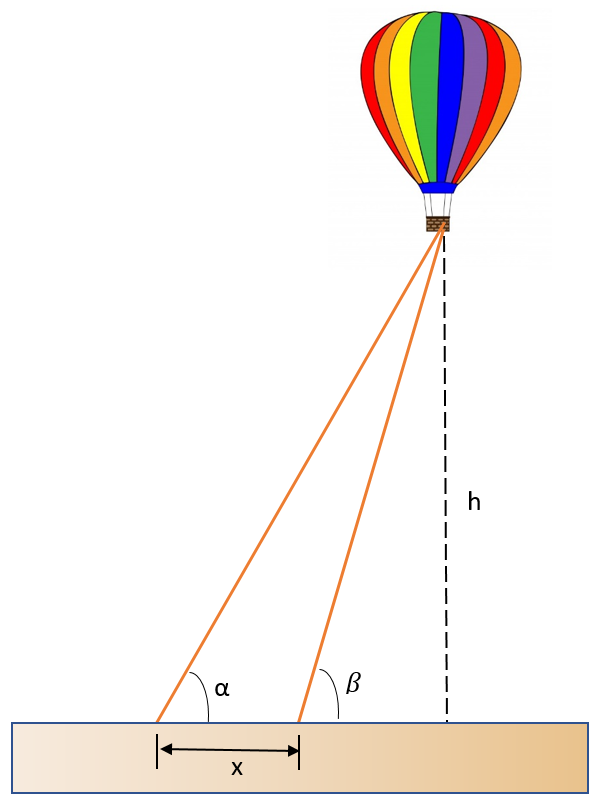
Two wires tether a balloon to the ground as shown in the following picture. Let \(\alpha=65^{\circ}, \beta=78^{\circ}\) and let \(x=95ft.\) Use the law of sines or cosines to find the value of \(h\text{,}\) the height the balloon is above the ground. Leave your answer in a simplified exact form.
Figure 26. Balloon tethered by two wires
Hint.
Use the law of sines to find the hypotenuse of the inner triangle. Then use right triangle trigonometry to find the height.
Answer.
\(h=\frac{95\sin65^{\circ}\sin78^{\circ}}{\sin13^{\circ}}\)
Solution.
First, we use the law of sines to find the hypotenuse of the inner triangle. \(\frac{\sin65^{\circ}}{y}=\frac{\sin13^{\circ}}{95}\) Solving for \(y\text{:}\) \(y=\frac{95\sin65^{\circ}}{\sin13^{\circ}}\) Then, we use right triangle trigonometry to find the height of the balloon. \(\sin78^{\circ}=\frac{h}{y}\) \(h=y\sin78^{\circ}\) \(h=\frac{95\sin65^{\circ}\sin78^{\circ}}{\sin13^{\circ}}\) ft

