
Section Double Integrals

Worksheet IC-1 Reading

All of the readings for this course come from the OpenStax Calculus Volume 3 textbook, which is available for free online at https://openstax.org/details/books/calculus-volume-3. You can read the textbook online or download a PDF version. The textbook is also available in print from various retailers if you prefer a physical copy.
For this lesson, you should read sections 5.1 Double Integrals over Rectangular Regions, 5.2 Double Integrals over General Regions, and 5.3 Double Integrals in Polar Coordinates. You should read through the sections carefully, making sure to understand the definitions, examples, and key ideas. You should also work through the exercises at the end of each section to test your understanding and practice applying the concepts. Some of the exercises at the end of the section are assigned in the WP assignments.

Worksheet IC-1 Videos

Double Integrals over Rectangular Regions
Double Integrals over General Regions
Double Integrals in Polar Coordinates

Worksheet IC-1 Written Practice

INFORMATION ABOUT ALL WRITTEN PRACTICE (WP) ASSIGNMENTS:
THE WP ASSIGNMENTS ARE DESIGNED TO PREPARE YOU FOR THE QUIZZES AND ASSESSMENTS
  • Work on every problem on every assignment.
  • If you get stuck or do not understand a solution, ask questions.
  • For each problem, try it once or twice before looking at solutions or asking for help.
  • Mark the problems you did correctly on the first try.
  • Highlight problems where you got help (using solutions, videos, a tutor, etc) -These are the problem types that you will need more practice on to be ready for the assessments.
  • Understand that just copying the solutions instead of working through the problems will greatly reduce your chances of success in this class.
WP10
Double Integrals over Rectangular Regions: Complete problems 5, 8, 17, 26, 29, 35
Double Integrals over General Regions: Complete problems 77, 83, 95, 101, 103
Double Integrals in Polar Coordinates: Complete problems 138, 139, 149, 153, 165
In addition to these problems, upload a link to a solution video: Pick one problem in the Double integrals in Polar Coordinates section problems 148-169 (the problems should not be any listed above). Create a short video of you presenting the solution to your classmates. You may use any video software (zoom, flip, explain everything, etc). The video does not need to be perfect or fully edited (mistakes are welcome), but it should show your thought process as you go through the solution.

Worksheet IC-1 Sample Outcomes

For the quiz on this outcome you would be given 40 minutes to complete 3 problems. Here are samples of the types of problems you will encounter:

1.

Evaluate \(\int_1^2 \int_0^1 (x+y)^{-2} dxdy\text{.}\)
Hint.
To evaluate this double integral, first integrate with respect to \(x\text{,}\) then with respect to \(y\text{.}\)
Answer.
\(\int_1^2 \int_0^1 (x+y)^{-2} dxdy = \ln\frac{4}{3}\)
Solution.
First integrate with respect to \(x\text{:}\)
\(\int_0^1 (x+y)^{-2} dx = \left[-(x+y)^{-1}\right]_0^1 = -(1+y)^{-1} + y^{-1}\)
Then integrate with respect to \(y\text{:}\)
\(\int_1^2 \left(-(1+y)^{-1} + y^{-1}\right) dy = \left[-\ln(1+y) + \ln(y)\right]_1^2 \)
\(\int_1^2 \left(-(1+y)^{-1} + y^{-1}\right) dy = -\ln3 + \ln 2 - (-\ln 2 +\ln 1)\)
\(\int_1^2 \left(-(1+y)^{-1} + y^{-1}\right) dy = \ln\frac{4}{3}\)

2.

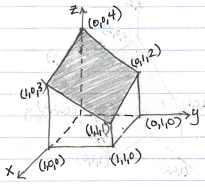
Sketch the solid described by \(\int_0^1 \int_0^1 (4-x-2y)dxdy\)
Hint.
Start by sketching the region in the xy-plane. Then, visualize the solid above this region.
Answer.

3.

Evaluate \(\iint_D xy^2 dA\) where \(D\) is the region bounded by the curves \(y=2x, x=0,\) and \(y=4\text{.}\)
(a)
Sketch the region \(D\text{.}\)
Answer.
Diagram Exploration Keyboard Controls
Key Action
Enter, A Activate keyboard driven exploration
B Activate menu driven exploration
Escape Leave exploration mode
Cursor down Explore next lower level
Cursor up Explore next upper level
Cursor right Explore next element on level
Cursor left Explore previous element on level
X Toggle expert mode
W Extra details if available
Space Repeat speech
M Activate step magnification
Comma Activate direct magnification
N Deactivate magnification
Z Toggle subtitles
C Cycle contrast settings
T Monochrome colours
L Toggle language (if available)
K Kill current sound
Y Stop sound output
O Start and stop sonification
P Repeat sonification output
(b)
Set up the double integral and evaluate it.
Hint.
Using the region D from the previous task, set up the double integral based on the bounds.
Answer.
\(\iint_D xy^2 dA = \frac{128}{5}\)
Solution.
Since D is the triangular region with vertices (0,0), (2,4) and (4,0), we have that \(0 \leq x \leq 2\) and \(2x \leq y \leq 4\text{.}\) Therefore, the double integral is:
\(\iint_D xy^2 dA = \int_0^2 \int_{2x}^4 xy^2 dy dx\)
\(\iint_D xy^2 dA = \int_0^2 \frac{1}{3}xy^3 \Big|_{2x}^4 dx\)
\(\iint_D xy^2 dA = \int_0^2 \left(\frac{64}{3}x-\frac{8}{3}x^4\right) dx\)
\(\iint_D xy^2 dA = \frac{64}{3} \cdot \frac{1}{2}x^2 - \frac{8}{3} \cdot \frac{1}{5}x^5 \Big|_0^2\)
\(\iint_D xy^2 dA = \frac{64}{3} \cdot 2 - \frac{8}{3} \cdot \frac{32}{5}\)
\(\iint_D xy^2 dA = \frac{128}{3} - \frac{256}{15}\)
\(\iint_D xy^2 dA = \frac{128}{5}\)

4.

Given double integral \(\int_0^2 \int_0^{\sqrt{4-x^2}} 8\sqrt{x^2+y^2}dydx\)
(a)
Graph the region of integration.
Hint.
Start by identifying the region of integration and converting to polar coordinates.
Answer.
Diagram Exploration Keyboard Controls
Key Action
Enter, A Activate keyboard driven exploration
B Activate menu driven exploration
Escape Leave exploration mode
Cursor down Explore next lower level
Cursor up Explore next upper level
Cursor right Explore next element on level
Cursor left Explore previous element on level
X Toggle expert mode
W Extra details if available
Space Repeat speech
M Activate step magnification
Comma Activate direct magnification
N Deactivate magnification
Z Toggle subtitles
C Cycle contrast settings
T Monochrome colours
L Toggle language (if available)
K Kill current sound
Y Stop sound output
O Start and stop sonification
P Repeat sonification output
(b)
Set up the double integral in polar coordinates and evaluate it.
Hint.
Convert the Cartesian coordinates to polar coordinates and adjust the limits of integration accordingly.
Answer.
\(\int_0^{\frac{\pi}{2}} \int_0^2 8r^2 drd\theta = \frac{32\pi}{3}\)
Solution.
First convert the integrand to polar coordinates: \(8\sqrt{x^2+y^2} = 8r\text{.}\) Then, the limits of integration are \(0 \leq r \leq 2\) and \(0 \leq \theta \leq \frac{\pi}{2}\text{.}\)
Integrating, we get:
\(\int_0^{\frac{\pi}{2}} \int_0^2 8r^2 drd\theta = \int_0^{\frac{\pi}{2}} \left[8r^3/3\right]_0^2 d\theta\)
\(\int_0^{\frac{\pi}{2}} \int_0^2 8r^2 drd\theta = \int_0^{\frac{\pi}{2}} \frac{64}{3} d\theta\)
\(\int_0^{\frac{\pi}{2}} \int_0^2 8r^2 drd\theta = \frac{64}{3} \cdot \frac{\pi}{2}\)
\(\int_0^{\frac{\pi}{2}} \int_0^2 8r^2 drd\theta = \frac{32\pi}{3}\)

5.

Given \(\int_0^{\frac{\pi}{3}} \int_0^{\sec\theta}29r^2\cos\theta drd\theta\)
(a)
Graph the region of integration.
Hint.
Start by identifying the region of integration and converting to polar coordinates.
Answer.
Diagram Exploration Keyboard Controls
Key Action
Enter, A Activate keyboard driven exploration
B Activate menu driven exploration
Escape Leave exploration mode
Cursor down Explore next lower level
Cursor up Explore next upper level
Cursor right Explore next element on level
Cursor left Explore previous element on level
X Toggle expert mode
W Extra details if available
Space Repeat speech
M Activate step magnification
Comma Activate direct magnification
N Deactivate magnification
Z Toggle subtitles
C Cycle contrast settings
T Monochrome colours
L Toggle language (if available)
K Kill current sound
Y Stop sound output
O Start and stop sonification
P Repeat sonification output
(b)
Convert the integral into Cartesian coordinates and evaluate it.
Hint.
Use the relationships \(x = r\cos\theta\) and \(y = r\sin\theta\) to convert the integrand and limits.
Answer.
\(\int_0^{\frac{\pi}{3}} \int_0^{\sec\theta}29r^2\cos\theta drd\theta= \frac{29\sqrt{3}}{3}\)
Solution.
First, convert the integrand to Cartesian coordinates: \(29r^2\cos\theta dr d\theta = 29xdydx\text{.}\) Then, the limits of integration are \(0 \leq x \leq 1\) and \(0 \leq y \leq \sqrt{3}x\text{.}\)
Integrating, we get:
\(\int_0^1 \int_0^{\sqrt{3}x} 29x dydx\)
\(= \int_0^1 29xy \Big|_0^{\sqrt{3}x} dx\)
\(= \int_0^1 29\sqrt{3}x^2 dx\)
\(= \frac{29\sqrt{3}}{3} x^3\Big|_0^1 dx\)
\(= \frac{29\sqrt{3}}{3} \cdot 1\)
\(= \frac{29\sqrt{3}}{3}\)

6.

Find the volume of the solid bounded above by the plane \(z=4+x+2y\text{,}\) on the sides by the cylinder \(x^2+y^2=4\text{,}\) and below by the xy-plane.
Hint.
Find the region in the xy-plane and set up the double integral. Use polar coordinates to evaluate it.
Answer.
Volume = \(16\pi\) \(units^3\)
Solution.
Rewriting the cylinder using polar coordinates: \(x^2+y^2=4 \rightarrow r^2=4 \rightarrow r=2\text{.}\) The region of integration is \(0 \leq r \leq 2\) and \(0 \leq \theta \leq 2\pi\text{.}\)
The integrand in polar coordinates is \(4+r\cos\theta+2r\sin\theta\text{.}\)
Integrating, we get:
\(\int_0^{2\pi} \int_0^2 (4+r\cos\theta+2r\sin\theta) r drd\theta\)
\(= \int_0^{2\pi} \left[4r + \frac{r^3}{3}\cos\theta + \frac{2r^3}{3}\sin\theta\right]_0^2 d\theta\)
\(= \int_0^{2\pi} \left(8 + \frac{8}{3}\cos\theta + \frac{16}{3}\sin\theta\right) d\theta\)
\(= 8\theta + \frac{8}{3}\sin\theta - \frac{16}{3}\cos\theta \Big|_0^{2\pi}\)
\(= 16\pi\)
