
Section Equations of Lines, Planes and Surfaces

Worksheet FUN-2 Reading

All of the readings for this course come from the OpenStax Calculus Volume 3 textbook, which is available for free online at https://openstax.org/details/books/calculus-volume-3. You can read the textbook online or download a PDF version. The textbook is also available in print from various retailers if you prefer a physical copy.
For this lesson, you should read sections 2.5 Equations of Lines and Planes in Space, 2.6 Quadric Surfaces, and 2.7 Cylindrical and Spherical Coordinates.. You should read through the sections carefully, making sure to understand the definitions, examples, and key ideas. You should also work through the exercises at the end of each section to test your understanding and practice applying the concepts. Some of the exercises at the end of the section are assigned in the WP assignments.

Worksheet FUN-2 Videos

Equations of Lines and Planes
Quadric Surfaces
Cylindrical and Spherical Coordinates

Subsection FUN-2 Written Practice

Worksheet Worksheet

INFORMATION ABOUT ALL WRITTEN PRACTICE (WP) ASSIGNMENTS:
THE WP ASSIGNMENTS ARE DESIGNED TO PREPARE YOU FOR THE QUIZZES AND ASSESSMENTS
  • Work on every problem on every assignment.
  • If you get stuck or do not understand a solution, ask questions.
  • For each problem, try it once or twice before looking at solutions or asking for help.
  • Mark the problems you did correctly on the first try.
  • Highlight problems where you got help (using solutions, videos, a tutor, etc) -These are the problem types that you will need more practice on to be ready for the assessments.
  • Understand that just copying the solutions instead of working through the problems will greatly reduce your chances of success in this class.
Equations of Lines and Planes: Complete problems 247, 251, 257, 269, 271, 279, 285
Quadric Surfaces: Complete problems 313-318, 323, 327, 339, 345
Cylindrical and Spherical Coordinates: Complete problems 363, 369, 387, 391, 399, 401, 405, 409, 411, 413
In addition to these problems, on separate paper complete the following exploration. This link Intersection of Planes will take you to the exploration. On the right side of the screen, you will be given some instructions and questions to answer. Follow the instructions and write out your answers to each of the questions. Don’t forget to give the equation...!
Worksheet FUN-2 Sample Outcomes

For the quiz on this outcome you would be given 50 minutes to complete 4 problems. Here are samples of the types of problems you will encounter:

1.

Give the equation for the line passing through the point (4,-1,5) and in the direction orthogonal to the plane with equation \(2x-5y+z=1\text{.}\) Give the parametric, symmetric, and vector equations.
Hint.
To find the equation of a line in 3D space, you need a point on the line and a direction vector. The direction vector should be orthogonal to the given plane.
Answer.
Parametric: \(\vec{r}(t) = \lt 4, -1, 5 \gt + t \lt 2, -5, 1 \gt\)
Symmetric: \(\frac{x-4}{2} = \frac{y+1}{-5} = \frac{z-5}{1}\)
Vector: \(\vec{v}(t) = \lt 4+2t, -1-5t, 5+t \gt\)
Solution.
First, we find the normal vector to the plane \(2x-5y+z=1\text{,}\) which is \(\vec{n} = \lt 2, -5, 1 \gt\text{.}\) This vector is orthogonal to the plane and can be used as the direction vector for the line.
Using the point (4, -1, 5) and the direction vector \(\vec{d} = \lt 2, -5, 1 \gt\text{,}\) we can write the parametric equations as:
\(x = 4 + 2t\text{,}\) \(y = -1 - 5t\text{,}\) \(z = 5 + t\)
The symmetric equations are:
\(\frac{x-4}{2} = \frac{y+1}{-5} = \frac{z-5}{1}\)
The vector equation is:
\(\vec{r}(t) = \lt 4, -1, 5 \gt + t \lt 2, -5, 1 \gt\)

2.

Find the equation of the plane that passes through the points (2,0,4), (1,3,5), and (2,-1,0).
Hint.
To find the equation of a plane through three points, you can use the cross product of two vectors formed by the points to find the normal vector.
Answer.
Plane: \(11x+4y-z=18\)
Solution.
We first find two vectors in the plane:
\(\vec{u} = (1,3,5) - (2,0,4) = \lt -1,3,1 \gt\)
\(\vec{v} = (2,-1,0) - (2,0,4) = \lt 0,-1,-4 \gt\)
The normal vector is:
\(\vec{n} = \vec{u} \times \vec{v} = \lt 3(-4) - 1(-1), 1(0) - (-1)(-4), (-1)(-1) - 3(0) \gt = \lt -12 + 1, 0 - 4, 1 - 0 \gt = \lt -11, -4, 1 \gt\)
The equation of the plane is:
\(-11(x-2) - 4(y-0) + 1(z-4) = 0\)
Simplifying:
\(-11x + 22 - 4y + z - 4 = 0\)
\(11x + 4y - z = 18\)

3.

A plane is given by the equation 3x-2y+x=4.
(a)
Find the equation of a plane parallel to the given plane that passes through the point (-2,5,3).
Hint.
Parallel planes have the same normal vector.
Answer.
\(3x-2y+z=-13\)
Solution.
The normal vector to the given plane is \(\vec{n} = \lt 3, -2, 1 \gt\text{.}\) Since the new plane is parallel to the given plane, it has the same normal vector. Using the point (-2,5,3) and the normal vector \(\vec{n} = \lt 3, -2, 1 \gt\text{,}\) the equation of the new plane is:
\(3(x-(-2)) - 2(y-5) + 1(z-3) = 0\)
Simplifying:
\(3x + 6 - 2y + 10 + z - 3 = 0\)
\(3x - 2y + z + 13 = 0\)
Therefore, the equation of the new plane is:
\(3x - 2y + z = -13\)
(b)
Find the angle between the given plane and the xy-coordinate plane. Give an exact simplified answer.
Hint.
To find the angle between two planes, you can use the dot product of their normal vectors.
Answer.
\(\theta=cos^{-1}\left(\frac{\sqrt{14}}{14}\right)\)
Solution.
The normal vector to the given plane is \(\vec{n_1} = \lt 3, -2, 1 \gt\text{.}\) The normal vector to the xy-coordinate plane is \(\vec{n_2} = \lt 0, 0, 1 \gt\text{.}\) The angle between the planes is:
\(\cos(\theta) = \frac{\vec{n_1} \cdot \vec{n_2}}{|\vec{n_1}||\vec{n_2}|} = \frac{1}{\sqrt{14} \cdot 1} = \frac{1}{\sqrt{14}}\)
Therefore, \(\theta = \cos^{-1}\left(\frac{1}{\sqrt{14}}\right) = \cos^{-1}\left(\frac{\sqrt{14}}{14}\right)\)

4.

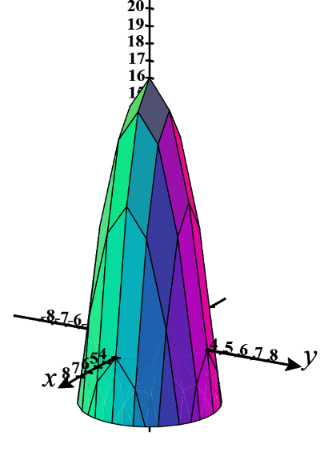
Identify the surface given by \(z=16-x^2-y^2\)
Answer.
Solution.
The equation \(z=16-x^2-y^2\) can be rewritten as \(x^2+y^2+z=16\text{.}\) This is the equation of an elliptic paraboloid opening downward with vertex at (0,0,16).

5.

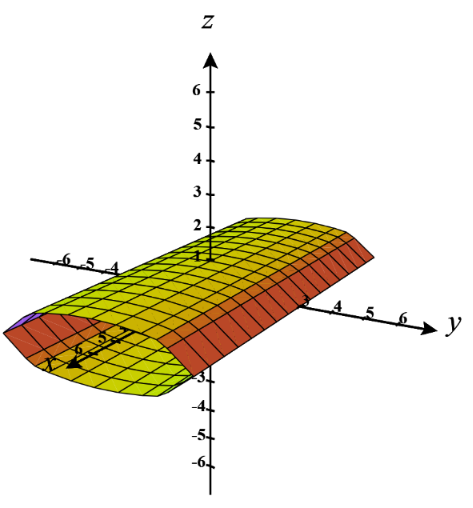
Identify the surface given by \(y^2+9z^2=9\)
Answer.
Figure 10. Elliptic Cylinder
Solution.
The equation \(y^2+9z^2=9\) can be rewritten as \(\frac{y^2}{9}+\frac{z^2}{1}=1\text{.}\) This is the equation of an elliptic cylinder opening along the x-axis with semi-axes of length 3 and 1.

6.

Given \(4x^2-y^2+z^2-8x+2y+2z+3=0\text{.}\)
(a)
Rewrite the equation in standard form.
Hint.
To find the standard form, complete the square for each variable, then simplify the equation.
Answer.
\(4(x-1)^2-(y-1)^2+(z+1)^2=1\)
Solution.
First we can get the like variables together:
\(4x^2-8x-y^2+2y+z^2+2z+3=0\)
We then need to factor out the leading coefficient for each set of variables: \(4(x^2-2x)- (y^2-2y)+(z^2+2z)+3=0\)
Completing the square for each variable, we add the constants:
\(4(x^2-2x+1)- (y^2-2y+1)+(z^2+2z+1)=-3+4-1+1\)
Then we can rewrite the equation as:
\(4(x-1)^2-(y-1)^2+(z+1)^2=1\)

