Skip to main content
Contents Embed Dark Mode Prev Up Next \(\newcommand{\N}{\mathbb N}
\newcommand{\Z}{\mathbb Z}
\newcommand{\Q}{\mathbb Q}
\newcommand{\R}{\mathbb R}
\newcommand{\lt}{<}
\newcommand{\gt}{>}
\newcommand{\amp}{&}
\definecolor{fillinmathshade}{gray}{0.9}
\newcommand{\fillinmath}[1]{\mathchoice{\colorbox{fillinmathshade}{$\displaystyle \phantom{\,#1\,}$}}{\colorbox{fillinmathshade}{$\textstyle \phantom{\,#1\,}$}}{\colorbox{fillinmathshade}{$\scriptstyle \phantom{\,#1\,}$}}{\colorbox{fillinmathshade}{$\scriptscriptstyle\phantom{\,#1\,}$}}}
\)
Section Triple Integrals
Worksheet IC-2 Reading
Objectives
Things you should understand and know:
Recognize when a function of three variables is integrable over a rectangular region or a closed and bounded region
Recognize when changing the order of integration may be needed
Understand what cylindrical boxes are and how these are used in evaluating triple integrals
Understand what spherical boxes are and how these are used in evaluating triple integrals
Things you should be able to do:
Use properties to evaluate triple integrals
Evaluate a triple integral over a rectangular by writing it as an iterated integral
Use triple integrals to calculate volumes and average values
Simplify the calculation of an iterated integral by changing the order of integration
Evaluate a triple integral by changing to cylindrical coordinates
Evaluate a triple integral by changing to spherical coordinates
You will be assessed on the following criteria:
Problem structure: Solution should be organized and easy to follow, with clear, complete steps that follow progressively from one to the next.
Triple Integrals: Compute triple integrals over rectangular regions. Compute the volumes of solids using triple integrals. Solve applied problems using triple integrals.
Triple Integrals in Cylindrical and Spherical Coordinates: Compute triple integrals in cylindrical and spherical coordinates. Compute the volumes of solids using triple integrals in cylindrical and spherical coordinates. Solve applied problems using triple integrals in cylindrical and spherical coordinates.
All of the readings for this course come from the OpenStax Calculus Volume 3 textbook, which is available for free online at
https://openstax.org/details/books/calculus-volume-3 . You can read the textbook online or download a PDF version. The textbook is also available in print from various retailers if you prefer a physical copy.
For this lesson, you should read sections
5.4 Triple Integrals , and
5.5 Triple Integrals in Cylindrical and Spherical Coordinates . You should read through the sections carefully, making sure to understand the definitions, examples, and key ideas. You should also work through the exercises at the end of each section to test your understanding and practice applying the concepts. Some of the exercises at the end of the section are assigned in the WP assignments.
Worksheet IC-2 Videos
Triple Integrals in Cylindrical and Spherical Coordinates
Worksheet IC-2 Written Practice
INFORMATION ABOUT ALL WRITTEN PRACTICE (WP) ASSIGNMENTS:
THE WP ASSIGNMENTS ARE DESIGNED TO PREPARE YOU FOR THE QUIZZES AND ASSESSMENTS
Work on every problem on every assignment.
If you get stuck or do not understand a solution, ask questions.
For each problem, try it once or twice before looking at solutions or asking for help.
Mark the problems you did correctly on the first try.
Highlight problems where you got help (using solutions, videos, a tutor, etc) -These are the problem types that you will need more practice on to be ready for the assessments.
Understand that just copying the solutions instead of working through the problems will greatly reduce your chances of success in this class.
Triple Integrals: Complete problems 185, 195, 222, 236
Triple Integrals in Cylindrical and Spherical Coordinates: Complete problems 241, 250, 260, 262, 295
Worksheet IC-2 Sample Outcomes
For the quiz on this outcome you would be given 40 minutes to complete 3 problems. For these you will be asked to set up all three problems and evaluate one of each type (cartesian, cylindrical, and spherical). Here are samples of the types of problems you will encounter:
1. Evaluate the triple integral
\(\int_0^1 \int_0^2 \int_0^{x+3y} (3x+y)dz dy dx\)
Hint .
To integrate the triple integral, first integrate with respect to
\(z\text{,}\) then with respect to
\(y\text{,}\) and finally with respect to
\(x\text{.}\)
Answer .
\(\int_0^1 \int_0^2 \int_0^{x+3y} (3x+y)dz dy dx = 20\)
Solution .
To integrate the triple integral, first integrate with respect to
\(z\text{:}\)
\(\int_0^1 \int_0^2 \int_0^{x+3y} (3x+y)dz dy dx = \int_0^1 \int_0^2 (3x+y)z \Big|_0^{x+3y} dy dx\)
\(= \int_0^1 \int_0^2 (3x+y)(x+3y) dy dx\)
\(= \int_0^1 \int_0^2 (3x^2 + 10xy + 3y^2) dy dx\)
\(= \int_0^1 \left[ 3x^2y + 5xy^2 + y^3 \right]_0^2 dx\)
\(= \int_0^1 (6x^2 + 20x + 8) dx\)
\(= \left[ 2x^3 + 10x^2 + 8x \right]_0^1\)
2. Given
\(\iiint_E xz dV\) where
\(T\) is the solid tetrahedron with vertices
\((0,0,0), (1,0,0), (0,0,1),\) and
\((0,1,0)\text{.}\)
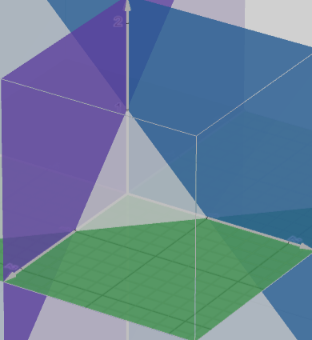
(a) Give a sketch of the solid.
(b) Set up the triple integrals and evaluate it.
Hint .
Use the bounds of the tetrahedron to set up the limits of integration.
Answer .
\(\iiint_E xz dV = \int_0^1 \int_0^{1-x} \int_0^{1-x-y} xz dz dy dx = \frac{1}{120}\)
Solution .
We can set up the bounds of the tetrahedron to set up the limits of integration. Since
\(0 \leq x \leq 1\text{,}\) \(0 \leq y \leq 1-x\text{,}\) and
\(0 \leq z \leq 1-x-y\text{,}\) the triple integral is:
\(\iiint_E xz dV = \int_0^1 \int_0^{1-x} \int_0^{1-x-y} xz dz dy dx\)
Evaluating this integral, we start with the inner integral:
\(\iiint_E xz dV = \int_0^1 \int_0^{1-x} \int_0^{1-x-y} xz dz dy dx = \int_0^1 \int_0^{1-x} \left[ \frac{xz^2}{2} \right]_0^{1-x-y} dy dx\)
\(\iiint_E xz dV = \int_0^1 \int_0^{1-x} \frac{x(1-x-y)^2}{2} dy dx\)
\(\iiint_E xz dV = \int_0^1 \left[ \frac{x(1-x-y)^3}{6} \right]_0^{1-x} dx\)
\(\iiint_E xz dV = \int_0^1 \frac{x(1-x)^3}{6} dx\)
\(\iiint_E xz dV = \int_0^1 \frac{x(1-3x+3x^2-x^3)}{6} dx\)
\(\iiint_E xz dV = \frac{1}{6} \int_0^1 (x-3x^2+3x^3-x^4) dx\)
\(\iiint_E xz dV = \frac{1}{6} \left[ \frac{x^2}{2} - x^3 + \frac{3x^4}{4} - \frac{x^5}{5} \right]_0^1\)
\(\iiint_E xz dV = \frac{1}{6} \left( \frac{1}{2} - 1 + \frac{3}{4} - \frac{1}{5} \right)\)
\(\iiint_E xz dV = \frac{1}{6} \left( \frac{10-20+15-4}{20} \right)\)
\(\iiint_E xz dV = \frac{1}{6} \left( \frac{1}{20} \right)\)
\(\iiint_E xz dV = \frac{1}{120}\)
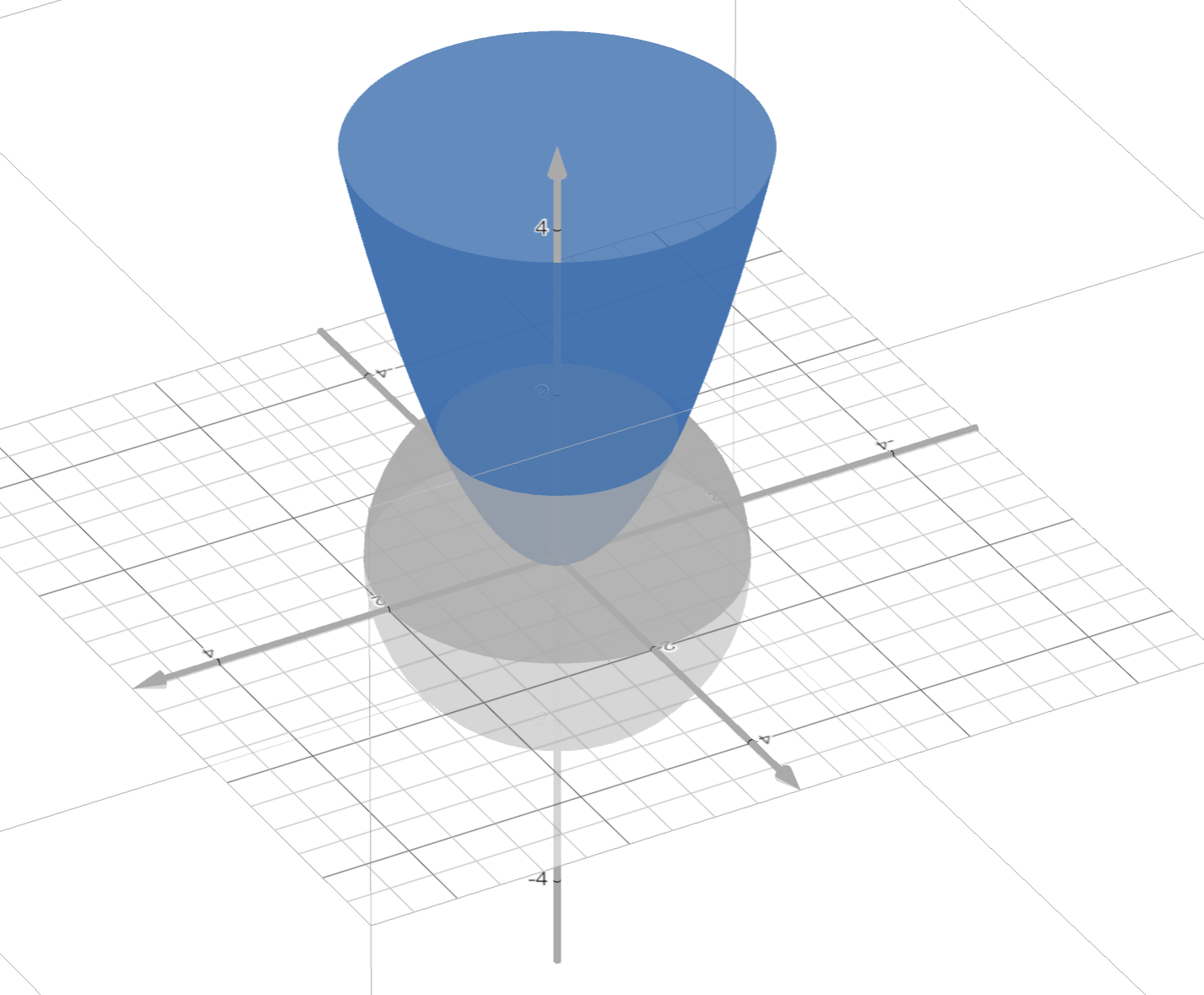
3. A solid is bounded by the paraboloid
\(z = x^2 + y^2\) and the sphere
\(x^2+y^2+z^2=4\text{.}\)
(a) (b) Set up the triple integral in Cartesian coordinates.
Hint .
Use the intersection of the surfaces to determine the bounds.
Answer .
\(\iiint_E f(x,y,z) dV = \int_{-2}^2 \int_{-\sqrt{4-x^2}}^{\sqrt{4-x^2}} \int_{x^2+y^2}^{\sqrt{4-x^2-y^2}} f(x,y,z) dz dy dx\)
(c) Set up the triple integral in cylindrical coordinates.
Hint .
Use the conversions to change variables to cylindrical coordinates.
Answer .
\(\int_0^{2\pi} \int_0^2 \int_{r^2}^{\sqrt{4-r^2}} r dz dr d\theta = \frac{8\pi}{3}\)
Solution .
First we find the intersection of the surfaces:
\(x^2 + y^2 = 4 - x^2 - y^2\)
In cylindrical coordinates, this becomes
\(r^2 = 2\text{,}\) so
\(r = \sqrt{2}\text{.}\)
The limits of integration are:
\(0 \leq \theta \leq 2\pi\)
\(0 \leq r \leq \sqrt{2}\)
\(r^2 \leq z \leq \sqrt{4-r^2}\)
Therefore, the triple integral in cylindrical coordinates is:
\(\iiint_E f(x,y,z) dV = \int_0^{2\pi} \int_0^2 \int_{r^2}^{\sqrt{4-r^2}} r dz dr d\theta\)
Now we can evaluate the integral:
\(\iiint_E f(x,y,z) dV = \int_0^{2\pi} \int_0^2 \int_{r^2}^{\sqrt{4-r^2}} r dz dr d\theta\)
\(= \int_0^{2\pi} \int_0^2 r \left[ z \right]_{r^2}^{\sqrt{4-r^2}} dr d\theta\)
\(= \int_0^{2\pi} \int_0^2 r \left( \sqrt{4-r^2} - r^2 \right) dr d\theta\)
\(= \int_0^{2\pi} \int_0^2 r\sqrt{4-r^2} - r^3 dr d\theta\)
\(= \int_0^{2\pi} \left[ -\frac{2}{3}(4-r^2)^{3/2} + \frac{r^4}{4} \right]_0^2 d\theta\)
\(= \int_0^{2\pi} \left( -\frac{2}{3}(4-4)^{3/2} - \frac{16}{4} - \left( -\frac{2}{3}(4-0)^{3/2} - 0 \right) \right) d\theta\)
\(= \int_0^{2\pi} \left( -4 + \frac{2}{3} \cdot 8 \right) d\theta\)
\(= \int_0^{2\pi} \left(\frac{4}{3} \right) d\theta\)
\(= \frac{4}{3} \cdot 2\pi\)
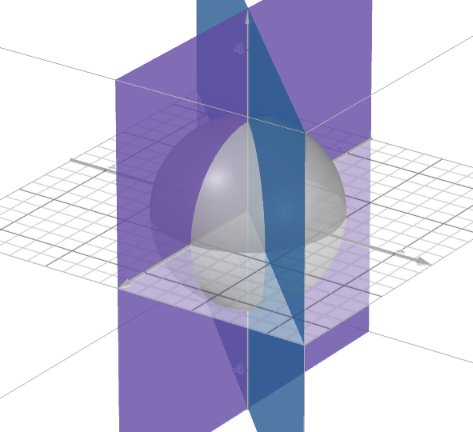
4. A solid is formed by the smaller edge cut from a sphere of radius 5, by the planes that intersect along a diameter at an angle of
\(\frac{\pi}{4}\text{.}\)
(a) (b) Set up the triple integral in Cartesian coordinates.
Hint .
Use the intersection of the surfaces to determine the bounds.
Answer .
\(\iiint_E f(x,y,z) dV = \int_{0}^{\sqrt{5}} \int_0^{\sqrt{5-x^2}} \int_{-\sqrt{5-x^2-y^2}}^{\sqrt{5-x^2-y^2}} dz dy dx\)
(c) Set up the triple integral in spherical coordinates.
Hint .
Use the conversions to change variables to spherical coordinates.
Answer .
\(\int_0^{\frac{\pi}{4}} \int_0^{\pi} \int_0^5 \rho^2 \sin(\phi) d\rho d\phi d\theta = \frac{125\pi}{6}\)
Solution .
In spherical coordinates, the limits of integration are:
\(0 \leq \theta \leq \frac{\pi}{4}\)
Therefore, the triple integral in spherical coordinates is:
\(\iiint_E f(x,y,z) dV = \int_0^{\frac{\pi}{4}} \int_0^{\pi} \int_0^5 \rho^2 \sin(\phi) d\rho d\phi d\theta\)
Now we can evaluate the integral:
\(\iiint_E f(x,y,z) dV = \int_0^{\frac{\pi}{4}} \int_0^{\pi} \int_0^5 \rho^2 \sin(\phi) d\rho d\phi d\theta\)
\(= \int_0^{\frac{\pi}{4}} \int_0^{\pi} \left[ \frac{\rho^3}{3} \right]_0^5 \sin(\phi) d\phi d\theta\)
\(= \int_0^{\frac{\pi}{4}} \int_0^{\pi} \frac{125}{3} \sin(\phi) d\phi d\theta\)
\(= \int_0^{\frac{\pi}{4}} \left[ -\frac{125}{3} \cos(\phi) \right]_0^{\pi} d\theta\)
\(= \int_0^{\frac{\pi}{4}} \frac{125}{3} (1 - (-1))) d\theta\)
\(= \int_0^{\frac{\pi}{4}} \frac{250}{3} d\theta\)
\(= \frac{250}{3} \cdot \frac{\pi}{4}\)